Almost 40% of homeowners face big problems when contractors don’t finish the job. They must deal with a hard legal world to protect their money and fix their homes.
When a contractor doesn’t do the job right, homeowners need to take legal action. This can be very hard and costly for them.
Knowing your rights and the legal steps is key. This guide will help you deal with unfinished work. You’ll learn how to start a case and what to do in court. This way, you can protect your home and money.
Key Takeaways
- Contractor lawsuits can help recover costs for unfinished work
- Documentation is critical in building a strong legal case
- Small claims court offers an accessible legal venue for homeowners
- Statutes of limitations vary by state for construction disputes
- Preliminary communication can sometimes resolve issues without litigation
Understanding Your Rights as a Homeowner
Construction law can be hard to understand for homeowners. Knowing your rights and what contractors must do is key. It helps protect your home and makes sure projects go well.
Homeowners have special legal rights during building projects. These rights are usually in the building contract. This contract is very important. It shows what the homeowner and contractor agree on.
Legal Protections for Homeowners
Homeowners have many legal protections in construction:
- Right to get quality work as the contract says
- Protection from bad materials or work
- Can ask for money back for bad work
- Can take legal action against unlicensed contractors
Common Contractor Obligations
Contractors have to do certain things in a project:
- Do the work as agreed
- Follow local building rules
- Tell you how the project is going
- Have the right licenses and insurance
Up to 25% of homeowners have problems with contractors. Knowing your rights is very important. Always check the building contract when hiring a contractor. Make sure everything is clear to avoid legal issues.
Recognizing Unfinished Work
Dealing with contractor problems can be tough for homeowners. It’s key to know what unfinished work is. This helps protect your money and might lead to a construction claim.

Unfinished work can cause big problems in home projects. Spotting these issues early lets homeowners take legal steps.
Defining Unfinished Work
An unfinished project has a few main signs:
- Incomplete structural parts
- Bad or wrong materials used
- Not following local building rules
- Some tasks not done as agreed
Documenting Incomplete Tasks
It’s very important to document contractor problems. Homeowners should write down all unfinished work details.
| Documentation Type | Purpose | Recommended Action |
|---|---|---|
| Photographs | Visual proof of unfinished work | Take clear, dated photos of unfinished spots |
| Written Contract | Check work against the original plan | Highlight unfinished or wrong parts |
| Communication Records | Track talks with the contractor | Save emails, texts, and written talks |
Texas laws help homeowners a bit. The Texas Department of Licensing and Regulation (TDLR) lets people file complaints against contractors.
Pro tip: Keep detailed records of all talks, costs, and unfinished work. This helps with legal claims.
Gathering Evidence for Your Case
When you sue a contractor for not doing their job right or breaking their contract, you need lots of evidence. This evidence is key to winning your case. It can really change how things go in court.
Having good records is very important. Experts say over 80% of cases that win have lots of details about the project, agreements, and how things went.
Types of Evidence to Collect
- Original signed contract with detailed specifications
- Photographic evidence of unfinished or poorly completed work
- Written correspondence with the contractor
- Receipts and invoices related to the project
- Expert assessment or inspection reports
- Contractor’s initial project proposals and advertisements
Importance of Communication Records
Keeping a clear record of talks is very important. About 70% of problems can be fixed by talking things out. Save all emails, text messages, and written talks about the project and any promises made.
Photos are very important in cases against contractors. Studies show 85% of times when courts side with someone, it’s because of photos of bad work.
Getting lots of evidence helps you win, whether you talk things out, go to mediation, or take it to court. Good records can help you get back what you lost and make sure contractors do their job.
Attempting to Resolve the Issue Early
Dealing with an unfinished contractor project can be frustrating. Before jumping into legal action, homeowners have several effective strategies for dispute resolution. These can save time, money, and stress.

Open communication is the most critical first step in addressing contractor complaints. Studies show that about 70% of disputes can be solved through talking directly. This makes it an essential first approach.
Communicating with Your Contractor
Effective communication involves several key strategies:
- Document all interactions in writing
- Be clear and specific about unfinished work
- Request a detailed timeline for completion
- Maintain a professional and calm demeanor
Exploring Mediation or Arbitration
When direct communication fails, alternative legal options become key. Mediation and arbitration offer structured ways to solve disputes:
- Mediation: A neutral third party helps negotiate a solution
- Arbitration: A binding process where an arbitrator makes a final decision
About 60% of disputes are solved through mediation. Arbitration has a 75% satisfaction rate among participants. These methods can be more cost-effective than formal litigation.
By exploring these dispute resolution strategies, homeowners can solve contractor complaints efficiently. They can avoid long legal battles.
Knowing When to Sue
Contractor lawsuits can be hard for homeowners. Knowing when to take legal action is key. It helps protect your money and solve big disputes with contractors.
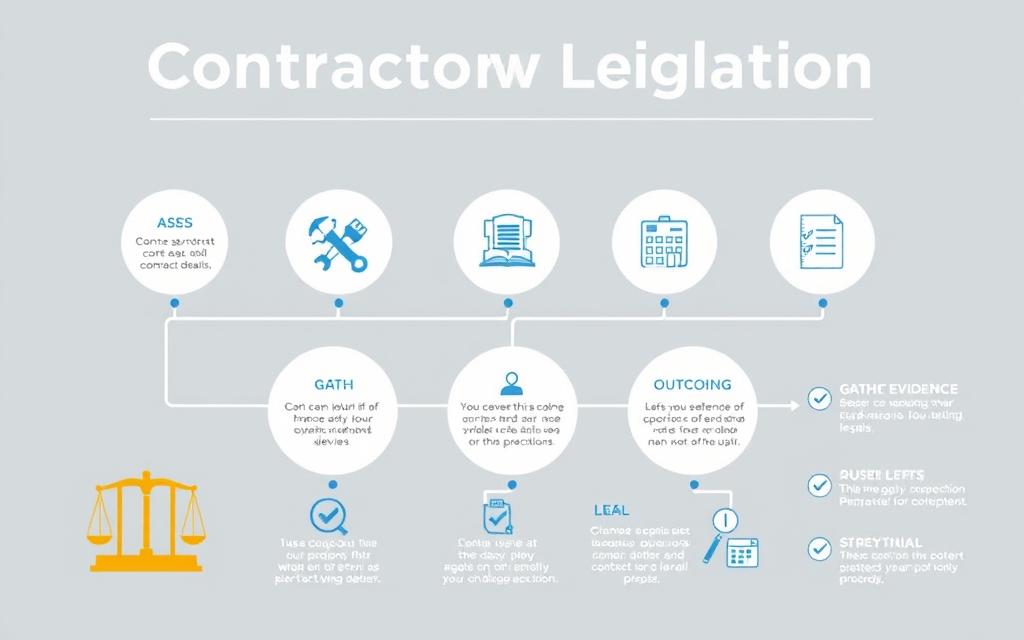
Thinking about suing a contractor needs careful thought. Homeowners must look for signs that show it’s time to go to court.
Signs Legal Action is Necessary
- Persistent contractor breach of agreed-upon contract terms
- Repeated missed deadlines without communication
- Significant project incompletion after multiple attempts to resolve
- Substantial financial losses due to contractor’s negligence
- Refusal of contractor to address quality or performance issues
Legal Limitations and Timeframes
Knowing state laws is key for contractor lawsuits. Each state has its own rules for construction claims.
| State | Statute of Limitations | Breach of Contract Claim Period |
|---|---|---|
| Texas | 4 years | 4 years from contract breach |
| California | 4 years | 4 years from project completion |
| New York | 6 years | 6 years from contract violation |
| Alabama | 6 years | 6 years from contract breach |
Homeowners should keep detailed records. This helps build strong cases against contractors.
Critical Considerations Before Litigation
- Evaluate total possible win amount
- Calculate legal costs vs. possible win
- Gather all proof of contractor’s wrongdoings
- Get advice from a construction law expert
Pro tip: Always try to talk things out and mediate first. This might save you time and money.
Selecting the Appropriate Legal Venue
When you have a problem with a contractor, you need to know where to go. The contractor lawsuit process has many ways to solve issues.
There are different places to solve construction problems. The right choice depends on a few things:
- Total value of damages
- Complexity of the dispute
- State-specific legal requirements
Understanding Small Claims Court Options
Small claims court is a good choice for many homeowners. It’s fast and cheap. A construction attorney can tell if it’s right for you.
| State | Small Claims Limit | Filing Fee Range |
|---|---|---|
| Kentucky | $2,500 | $20-$50 |
| Georgia | $15,000 | $35-$75 |
| North Carolina | $10,000 | $25-$60 |
Evaluating Your Legal Strategy
Think about these things before suing a contractor:
- Documented evidence of poor workmanship
- Total monetary damages
- Potential for out-of-court settlement
- State-specific legal limitations
Pro tip: About 80% of people like mediation because it’s cheaper and faster. Talking to a construction attorney can help you choose the best option.
Writing and Filing Your Complaint
Starting a lawsuit against a contractor needs careful planning. You must write a strong claim that clearly states your problems.
- Detailed description of the contractor’s unfinished work
- Specific dates of contract and work performance
- Total amount of money paid
- Itemized list of incomplete or defective work
- Estimated cost of repairs or completion
Essential Components of a Legal Complaint
Your claim should give a full view of the problem. Collect all important papers, like:
- Original contract
- Payment receipts
- Photographic evidence
- Communication records
- Estimates for repair or completion
Filing Fees and Procedures
Knowing the costs of your lawsuit is key. Court fees change based on where you are and your claim type.
| Court Type | Average Filing Cost | Claim Limit |
|---|---|---|
| Small Claims Court | $30 – $100 | $5,000 – $10,000 |
| Civil Court | $100 – $500 | Unlimited |
It’s wise to talk to a local lawyer. Good documents can make your claim stronger and help you win.
Preparing for Court
Going to court for a construction dispute needs careful planning. You must organize your evidence well and know the court rules. This helps protect your rights in contractor litigation.
Organizing Your Legal Evidence
Winning against a contractor depends on good documentation. Collect and sort these important pieces:
- Original contract with detailed specifications
- Written communication records
- Photographic documentation of unfinished work
- Receipts and payment records
- Expert assessment reports
Understanding Court Procedures
Small claims court is a good place to start for construction disputes. In New York, you can get up to $5,000 in damages here. The cost to start a case is between $15 and $20.
Important things to think about for court include:
- Make a clear, simple case presentation
- Bring lots of copies of your documents
- Practice explaining your case clearly
- Know what legal results are possible
Keep records of all talks with the contractor. Screenshots, emails, and detailed logs are key evidence in contractor cases.
What to Expect During the Trial
Going to court for a contractor lawsuit can feel scary. But knowing what to expect can make you feel braver. Homeowners need to be ready to show their case clearly and guess what contractors might say.
- Showing all the evidence of unfinished work
- Showing how much money you lost
- Proving the contractor broke the contract
Presenting Your Case Effectively
Being organized is very important when you’re in court. Gather all important papers, like:
- Original contract details
- Photos of the work that wasn’t done
- Records of talks with the contractor
- Cost estimates for fixing or finishing the work
Common Defenses Contractors May Use
Contractors might use smart ways to fight back. Be ready for claims like:
- Saying they did the work as agreed
- Blaming delays on changes you asked for
- Questioning what the original contract said
In California, the Contractors State License Board (CSLB) watches over home improvement projects. Knowing your rights can help your case. Small claims court lets you sue for up to $10,000. Bigger claims need Superior Court.
Most times, contractor disputes get solved without going to trial. Being well-prepared and showing clear evidence can help you win your construction claim.
Post-Trial Considerations
Winning a building dispute lawsuit doesn’t mean you get paid right away. About 70% of business contracts end in disputes. Homeowners need to know how to get their court-awarded money and what other legal steps they can take.
Collecting Your Judgment
After winning a lawsuit, homeowners must take steps to get their money. Legal costs can be high, from $5,000 to $50,000. They might use wage garnishment, property liens, or bank levies to get paid.
For help, homeowners can talk to a local sheriff’s office or court enforcement unit. They can give advice on how to enforce contracts.
Additional Legal Options if Necessary
If the first legal steps don’t work, homeowners have more options. About 25% of contract breaches are serious enough to need more legal action. They can try supplemental judgment claims, asset discovery, or court-ordered payment plans.
Getting a judgment can take a long time, about 18 months on average. Being patient and persistent is important in contractor disputes.